-
2026 04 01
(Working Paper) Why have Americans lose faith in mainstream accounts of the economy? I propose mismatch-signaling theory: mainstream news signals elite beliefs, while online commentary signals public beliefs, causing elites to appear ``out of touch'' when news signals diverge from audiences' understanding of reality. I document a sustained mismatch between positive economic news and both negative sentiment and user commentary during the 2021--2025 vibecession in the United States: by 2022, consumer sentiment is better predicted by the tone of user comments than mainstream news. An original survey experiment shows that positive economic news causes economically dissatisfied readers to trust experts and media less, while juxtaposing positive news with negative user commentary causes trust declines even for readers without economic grievances. The results suggest a structural mechanism for institutional trust decline while highlighting the role of online commentary and news’ second-order effects in shaping political attitudes.
-
2026 03 15
with Jennifer Allen and Chris Barrie
(Working Paper) Social media platforms increasingly use consumption signals to rank content. Instead of relying on network based measures or predicted engagement (ie, likes or retweets), platforms simply optimize for whether users are likely to spend more time consuming content. We propose this leads to a phenomenon called digital rubbernecking, where content that is attention-grabbing because of toxicity or negativity is more likely to be surfaced in platforms that optimize for consumption. We test this using a simulated social media environment and custom-built ranking algorithms that either prioritize consumption or engagement signals.
-
2026 03 01
with Hye Young You
(Working Paper) What role do journalists play in how political debates are portrayed in mainstream news coverage? We answer this question using data on climate change in Congressional floor speeches and in mainstream and partisan US newspapers from 2012-2022. We find that Republican lawmakers primarily discuss the costs of climate regulation while Democrat lawmakers primarily discuss the urgency of climate action. However, the climate debate in mainstream newspapers is predominantly focused on urgency. We propose a theory of journalist selection, arguing that this effect is driven by journalists increasingly self sorting into newsrooms based on their perceived ideological position. We find that journalists who join mainstream newspapers later are more likely to focus on urgency and less likely to focus on economic costs in their articles compared to older journalists in the same year, newsroom, and section. However, the opposite pattern holds for journalists who join far right partisan newspapers.
-
2026 03 01
with Jamil Citavarese
(Working Paper) Keyword dictionaries remain widely used in text analysis for their simplicity and transparency, but their sensitivity to keyword selection and inability to account for context introduce measurement error that attenuates estimates and obscures real relationships. We introduce ambiguity-robust dictionaries, a text-as-data method that integrates dictionary interpretability with contextual word embeddings to produce more precise measures. Our method requires only a few researcher-identified anchor words tied to the target concept. We generate contextualized embeddings for all keyword instances, apply constrained fuzzy clustering to define a target cluster anchored to these words, and weight each instance by its cluster membership. We demonstrate the utility and precision of our method across three applications: UN environmental discourse, ethnic bias in Kenyan judicial politics, and negative moral language US congressional speech.
-
2025 08 27
with Kyuwon Lee, Simone Paci, Jeongmin Park, and Hye Young You
(PS: Political Science and Politics, 2025) This article explores the use of large language models (LLMs), specifically GPT, for enhancing information extraction from unstructured text in political science research. By automating the retrieval of explicit details from sources including historical documents, meeting minutes, news articles, and unstructured search results, GPT significantly reduces the time and resources required for data collection. The study highlights how GPT complements human research assistants, combining automated efficiency with human oversight to improve the reliability and depth of research. This integration not only makes comprehensive data collection more accessible; it also increases the overall research efficiency and scope of research. The article highlights GPT’s unique capabilities in information extraction and its potential to advance empirical research in the field. Additionally, we discuss ethical concerns related to student employment, privacy, bias, and environmental impact associated with the use of LLMs.
-
2024 05 08
Original Route on Rainbow Wall
-
2024 05 01
(Working Paper) Understanding the degree to which lengthy political texts such as manifestos, op-eds, or speeches support or oppose certain policy issues is essential to answering questions about the nature of polarization and public opinion. However, computational stance detection techniques used in political science focus on short texts do not model stance intensities. I describe a novel method leveraging large language models (LLMs) which accurately scales issue stance intensities in lengthy texts. The method (summarize-then-classify) overcomes LLM weaknesses in reasoning tasks using a multi-step procedure, identifying stance clues in the text before determining stance intensity. I use a new dataset of US newspaper editorials about affirmative action and the SemEval 2016 dataset of tweets about abortion legalization to measure performance. In comparison to baseline methods, StC performs particularly well when scaling stances of newspaper editorials, exhibits fewer signs of concerning biases, and is receptive to tuning techniques such as multiple response aggregation. The results highlight the applicability of LLMs for complex tasks such as stance scaling.
-
-
-
2023 02 09
Internal vs. external validity round 1
-
-
-
-
-
-
-
-
2023 01 24
contra the financial independence mindset
-
2023 01 23
Justifying more writing
-
2023 01 12
with Minali Aggarwal, Jennifer Allen, Alexander Coppock, Dan Frankowski, Solomon Messing, Kelly Zhang, James Barnes, Andrew Beasley, and Harry Hantman
(Nature Human Behavior, 2023) We present the results of a large, US$8.9 million campaign-wide field experiment, conducted among 2 million moderate- and low-information persuadable voters in five battleground states during the 2020 US presidential election. Treatment group participants were exposed to an 8-month-long advertising programme delivered via social media, designed to persuade people to vote against Donald Trump and for Joe Biden. We found no evidence that the programme increased or decreased turnout on average. We found evidence of differential turnout effects by modelled level of Trump support: the campaign increased voting among Biden leaners by 0.4 percentage points (s.e. = 0.2 pp) and decreased voting among Trump leaners by 0.3 percentage points (s.e. = 0.3 pp) for a difference in conditional average treatment effects of 0.7 points (t1,035,571 = −2.09; P = 0.036; points; 95% confidence interval = −0.014 to 0). An important but exploratory finding is that the strongest differential effects appear in early voting data, which may inform future work on early campaigning in a post-COVID electoral environment. Our results indicate that differential mobilization effects of even large digital advertising campaigns in presidential elections are likely to be modest.
-
2022 01 12
An interactive news map
-
2022 01 05
A kind of cost effective way to avoid upgrading my laptop.
-
2021 08 11
Recommendations and Semantics
-
2021 07 21
with Minali Aggarwal, Jennifer Allen, Dan Frankowski, and Solomon Messing
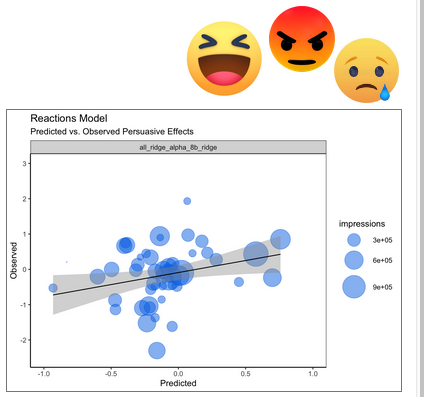
(Working Paper, IC2S2 2021) We examine a novel corpus of >80 RCTs testing the persuasiveness of political ads on Facebook ads and find no relationship between survey persuasion measures and common proxies for effectiveness like click-through-rate. However, we find emoji "reactions" are predictive of persuasion and use them to develop a surrogate metric.
-
2021 06 11
Reflections on two years
-
2021 01 05
a daily practice of audiovisual composition
-
2020 11 01
a musical composition that generates itself
-
2020 04 04
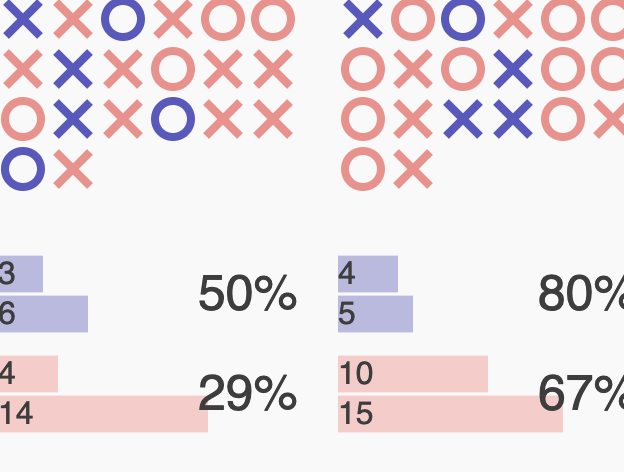
an interactive essay on the tradeoffs between differing definitions of algorithmic fairness
-
2019 10 14
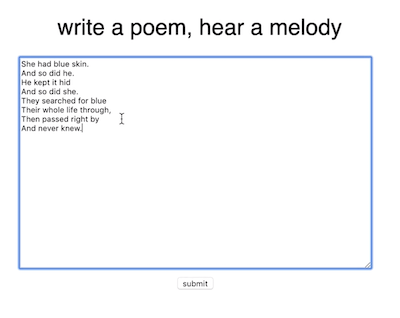
generating music from text
-
2018 09 08
Public Opinion was published in 1922 by Walter Lippmann, a...
Sign up for the mailing list
Mailing listees receive bespoke handcrafted emails composed of 100% recycled materials.